
This page is currently being reviewed; come back next week for a more polished version.
Even if rope can be enjoyed with just a few knots and hitches, it can still be fun to learn a few more to spice things up. To expand the toolbox, you can look at these techniques based on their properties, analyze the different options, and learn what might be useful in your practice.
The goal of this week is to explore the properties of knots and hitches and analyze in which contexts they can be useful when tying someone up.
Activities
Day 218: Attachment Knots
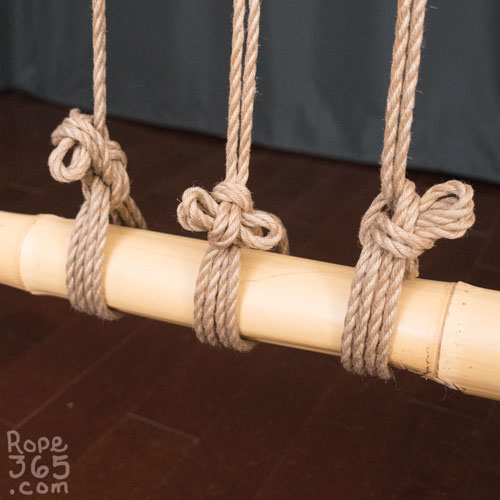
Every tie starts with a first attachment knot. If the single-column tie is the most common way to start a tie, there are many options. Double-column and multi-attachment knots are other options you can look into to start your tie in multiple places at the same time. You might also change which knot you use depending on whether you are tying a person or an object. Let’s take the time to compare the different options to start a tie, and which is the best for each context.
Day 219: Frictions and Inline Cuffs
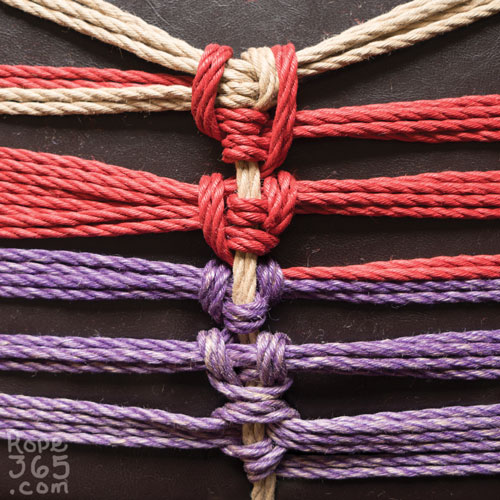
Many different techniques can be used to tie with the middle of the rope. Frictions are one of the most important types of hitches in bondage, always remaining easy to untie, as it is not fully locked. Many frictions, such as the L, X, and the full moon, have acquired names because they are efficient. Reality is that there is an infinity of possibilities of friction, and you can always create your own. Similarly, some cuff hitches are fast like the half hitch cuff but require tension to stay in place. Other speciality cuff allows to create a stable structure but usually takes longer to tie. Take some time to compare the different techniques, which one is better depending on the context, and how you can improvise a friction. Compare their speed, solidity and aesthetics.
- Basic frictions by Rope365
- Inline cuff by Rope365
- Cow hitch cuff by Rope365
- Captured overhand cuff by Topologist
- Double Half Hitch Second Column by Topologist
- Reverse Somerville Bowline by Eight of Swords
- Reverse Somerville Bowline by Beyonder
- Reverse Somerville Bowline by RopeDust
- Locking the midrope loop by Tracker
- The Midrope Loop Revisited by Innovative Fiber Arts
- Secondary column tie by Rope Connections
- Fast Reverse Somerville Bowline (Fast RSB) Tutorial by OmlessWanderer
- Rope Bondage Cage Legbinder by Kitten Mew
- Inline ‘quick and easy’ double column tie tutorial by mrluckiesrope
- Picture Ropemagic
Day 220: More Extension
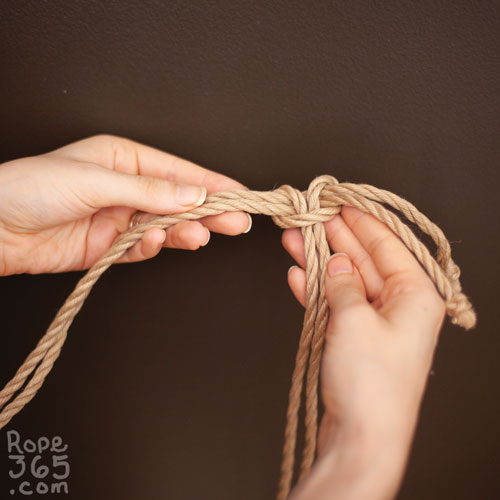
The family of knots used to extend rope is called bends. Some are easier to tie, some are very sturdy. Compare different methods such as the lark’s head, the square knot, and the sheet bend as they are all common in rope communities..
- Extending Rope by Rope365
- Rope Joints playlist by Rope365
- Joining Rope For Shibari by Bondage Tuition
- How to Extend Rope by Kinetik Speicher
- Sheet bend by perry_trees
- Bend knots by animated knot
- Sheet bend by Topologist
- Sheet bend and other techniques by Lux
- Sheet bend and other variations by Tracker
- Cheater’s sheetbent by Zylah
- Four different methods by -Steven-
- Tips to deal with uneven endings by MrLuckiesRope
- Overhand extension by Boundjock
- Photo by WhiskyFoxyTango
Day 221: Locks and Belay
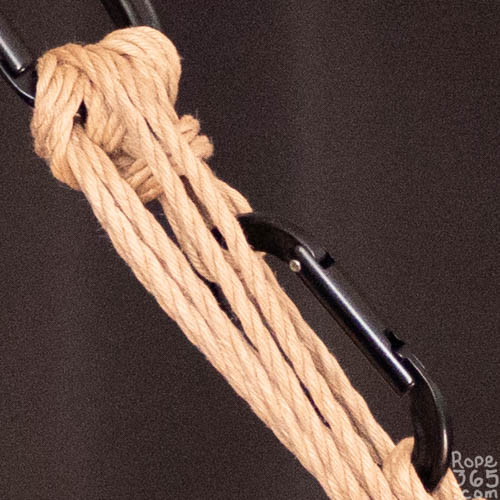
Many knots can be used to lock the rope in place. And sometimes we don’t want to completely lock, but add some friction for the rope to slide slowly in a belay. These two are interesting to combine, using a friction hitch such as the Munter Hitch to reduce speed, then adding a half hitch to turn it into a full lock quickly. Another interesting technique is to add a friction before a clove hitch to maintain some space to keep it easy to untie. Of course, many quick release knots can be used as a quick lock, but are also less stable.
Day 222: Loop Knots
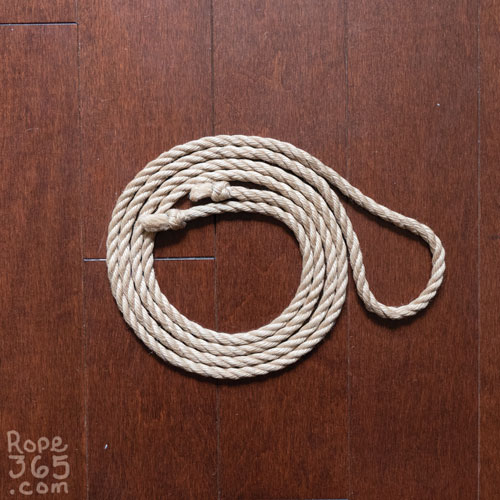
Loops can have a lot of fun uses; they can be tied at the end of a rope to make an easy slip knot, or in the middle of the rope to create an attachment point. This is great to create a pulley, to start a chain or a sinnet. You can also use multi-loop knots to create several loops. A common usage of a loop knot is to make one in the rope bight with a doubled rope to make it more solid for stability and pulley effects.
- The Hitch Guide – Alpine loop by Rory’s Brainworks (Clove hitch, girth hitch, cow hitch, alpine loop)
- The Chain Stitch Dress Tutorial by Rory’s Brainworks
- Perfection loop by TheBearEssentials
- End Loop Knots by Animated Knots
- Mid Loop Knots by Animated Knots
- Spanish bowline by Animated Knot
- Wide Y hang by ropemunkey
Day 223: Pulley Hitches
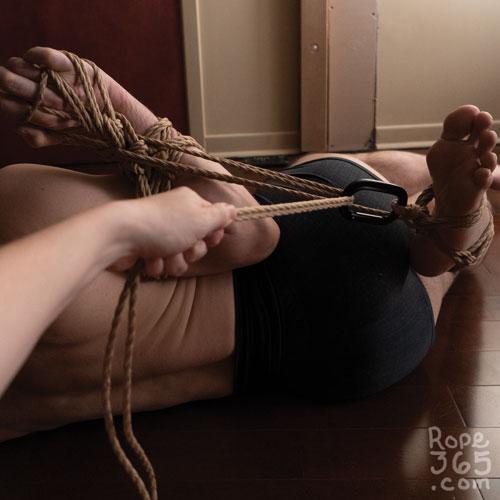
By looping rope through, we can create a pulley system that will give us a mechanical advantage when pulling on the rope. This is great to add tension; we can use it to make a hogtie tighter or with our bed frame to spread even more. Compare how adding a carabiner reduces friction and allows for smoother movement.

Day 224: Grippy and Adjustable Hitches
These hitches will tighten to remain in place and are great to create an attachment point on slippery surfaces. It’s fascinating how rope can hold on a slick dance pole with the right hitch. Using these hitches on the body will create a cuff that tightens, this can be fun as long as we are mindful of the safety aspect of it. We should avoid these hitches for safety lines as they can fail catastrophically when tension is removed.
These hitches can slide after having been tied. These are really practical when tying something that is likely to need to be adjusted afterward, when the level of tension needs to be at a great degree of precision, or just to have fun changing things without having to untie and retie.
- Icicle Hitch (end method) by Animated Knot
- Icicle Hitch (loop method) by Animated Knot
- Klemheist knot by Animated knot
- Prussik knot by Animated knot
- Magnus Hitch by Rope Dust
- How to Tie and Use the Pipe Hitch by SNO Multimedia
- How To Tie An Icicle Hitch Knot by WhyKnot
- Adjustable Grip Hitch by Animated knot
- Blake’s Hitch
- Farrimond hitch by Animated knot
- Zip snare tutorial by Boundjock
- Zip snare tutorial by Two Knotty Boys
- Zip snare tutorial by Watts the Safeword
Review
To complete the overview of knots and hitches, you can look at explorations in previous chapters.
Video References
We compiled a YouTube playlist with various videos on this topic; let us know if you find any others we should add to it. Note that video references may display risky or unstable techniques; viewer discretion is advised.
Gallery
Inspirations and Resources
- Collapsing and capsizing
- A Knotty Problem Solved by Nell Greenfieldboyce (Knots science)
- The Hitch Guide by Rory’s Brainworks (Clove hitch, girth hitch, cow hitch, alpine loop)
Or return to Fall for more options.